I’ll be the first to admit thatI am as guilty as anybody. At the proverbial drop of a hat, I can wax endlessly of the virtues and euphoria of carrying a .44 Special revolver or a 1911 in .45 ACP. But the very first magnum handgun—the .357 Magnum—seems to have been relegated to the Rodney Dangerfield corner. It just don’t get no respect, to quote the late comedian. It is much like the .30-06; it’s boring. Never mind the fact that both cartridges are perfectly capable of handling the shooting needs of more than 95 percent of shooters. They’re just old school.
My first centerfire handgun was a Smith & Wesson Model 27, an early 1970’s rendition of the original .357 Magnum revolver. A rough calculation shows that I have shoved a bit more than a half-ton of lead down its gullet and out its bore. If memory serves, there are about a dozen .357s calling the Campbell Homestead home right now. Regrettably, they have remained quiet for too long a time.
When the .357 Mag. was introduced in 1935 it rocked the world. It was the most powerful handgun in the world with factory ammunition. Douglass B. Wesson, who was vice president of the company and, along with Phil Sharpe, developed the cartridge and the revolver, went all over the country slaying everything from deer and antelope to moose and walrus. Today there are those who say the .357 Magnum will barely kill a small deer and only if the shot is placed with surgical precision.
From about the 1950s until somewhere around the mid-’80s the .357 Magnum was the darling of the law enforcement set. Its reputation as a fight stopper was pretty good, and it was only when the druggies started using machine guns that the LE guys felt they had to have a semi-auto with magazines that hold half a box of ammo each. The cartridge remains popular today, and just about any revolver is chambered for .357 as a start. A few rifles, notably lever-action rifles, have been and continue to be chambered for the cartridge. Winchester has recently reintroduced its iconic Model 1873 rifle with its initial chambering being .357 Magnum. You’ll be seeing a full review of it soon.
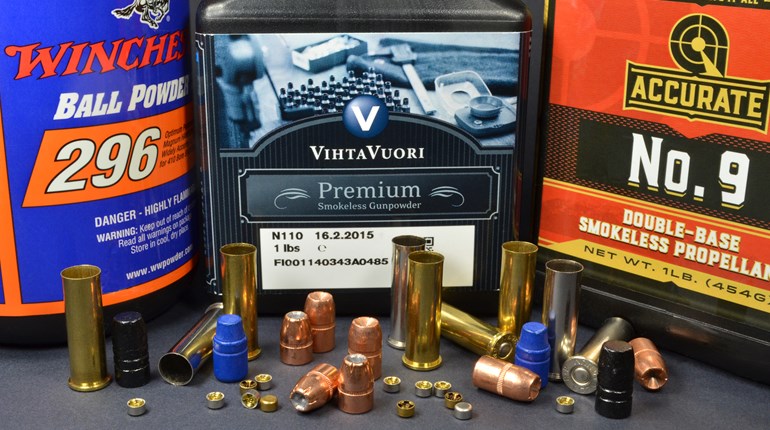
So while the .357 Mag. is still very much in use, few talk about it much. What re-piqued my interest in the old girl is a handloading project I am doing now. Over the years I have amassed a fair amount of .38 Special and .357 Mag. cases. I can load the .38 Special for general target shooting for pennies and save the magnum cases for more serious stuff. A 148-grain wadcutter cast from my scrap lead supply over 2.3 grains of Trail Boss provides an accurate and pleasant load for general fun shooting. Case life is nearly infinite—I am still loading some old surplus military cases with a 1956 headstamp date—and I know these cases have been loaded and shot at least 100 times. Switching to a linotype alloy and casting the RCBS semi-wadcutter that falls out of my molds at 155 grains; with 15 grains of Alliant 2400 under it I’ll get 1,480 fps from a 5-inch barrel in magnum cases. It’s not unpleasant to shoot and it’s accurate to boot. Any deer or bad guy that has the misfortune of stopping this bullet will have made an exceedingly poor life decision.
So between hunts for the next few months I’ll be dusting off some of my .357s and enjoying them all over again.