Even though we often have a rifle, shotgun or bow with us, it’s a very good idea for hunters to carry a handgun. It’s a dangerous world out there and a responsible person hopes for the best, but prepares for the worst.
As hunters, our handgun requirements are a bit different than an armed citizen walking on concrete. We may not only have to worry about dealing with bad people intent on doing us harm, but many hunters must consider the issue of predators that walk on four legs.
Another issue for hunters is that we may call on our handguns to shoot game when opportunity presents itself. That means the gun should be chambered in a cartridge powerful enough to do the job. It also means the gun should have good sights and a good trigger. The handgun (and the shooter) should be capable of placing a bullet with precision out to a reasonable range, say 25 yards or maybe more. Trying to head-shoot a rabbit at 20 yards with rudimentary sights and a 20-pound double-action trigger is not going to end well (except perhaps for the rabbit).
Comfort and ease of carry are important, too. Hunters already are packing a lot of gear so adding a big, heavy handgun is not always a good thing.
If you are not in bear country, most any gun you would carry on the street will also work for protection when hunting. I am a big-bore guy and prefer a .40 S&W or .45 ACP in a semi-auto pistol. You can never go wrong with the standards like a 1911, Glock, Smith & Wesson M&P or other popular personal-protection handgun. A pistol like the Smith & Wesson Shield in .40 S&W or .45 ACP packs a big punch, but is light enough to carry easily. I also like the .357 SIG. This cartridge shoots flat and hits hard. My friend George Harris, who writes for NRA’s Shooting Illustrated magazine, has taken several deer with his .357 SIG. I recently built a custom handgun in this cartridge for carry in any environment except bear country.
The 10mm Auto is often listed as a bear-defense cartridge by keyboard commandos for its “firepower,” but in real life it is in the same power range as the .357 Mag., which is a bit light for bears. For the rest of the world it’s an excellent choice: powerful enough to shoot deer-size big game and more than enough for personal protection against predators 200 pounds or less. Mine is the Remington R1 Long Slide 1911. This is a big handgun with a long sight radius, and it’s a great choice for carry, particularly for those times when I am not packing a rifle, when I’m scouting, hiking, clearing roads or cutting firewood.

It’s a good idea to stay away from smaller cartridges and most pocket pistols for protection in the woods; a handgun chambered in a small cartridge is not powerful enough to deal with a large predator. Also, in a wilderness setting you may have to take a longer shot. When a rabid coyote came for me, I was carrying a pocket-size .380. I tried several times to shoot him, but kept missing. I finally let him get uncomfortably close and managed to put him down. Now I carry a larger gun with good sights when I am in the woods.
A revolver is a great choice as it can be chambered for a more powerful cartridge than semi-autos. In this age of high-capacity, plastic handguns I still carry a small, powerful revolver almost every day. I have a hammerless Smith & Wesson M&P 340 revolver with a Crimson Trace Lasergrip that I carry in a pocket holster. It’s light, easy to conceal and very powerful. With the laser sight, I can shoot it well enough to make head shots on rabbits at 20 yards. When hunting, I often carry this revolver or its exposed-hammer twin, the M&P 360. They weigh less than a pound and are never a burden to carry. With proper ammo, the .357 Mag. is a powerful cartridge from even this short barrel, and is capable of handling predators to 200 pounds easily. I’ve used these guns to take small game and to finish off deer, as well as for protection. There are guns with longer barrels that might be a better choice, but these are so easy to carry that they are always with me. That counts for something.

If my handgun is my primary firearm while in the woods, I often carry a larger revolver. My favorite is a custom Mag-Na-Port/Smith & Wesson Model 629 .44 Mag. with a 2.5-inch barrel. There are a lot of really outstanding revolvers on the market, so it should be easy to find one you like. Another I pack a lot is a Ruger Blackhawk in .45 Colt. I have some powerful handloads that make this enough to hunt big game or protect me from anything in North America. Still, it’s relatively light and easy to pack in a holster.
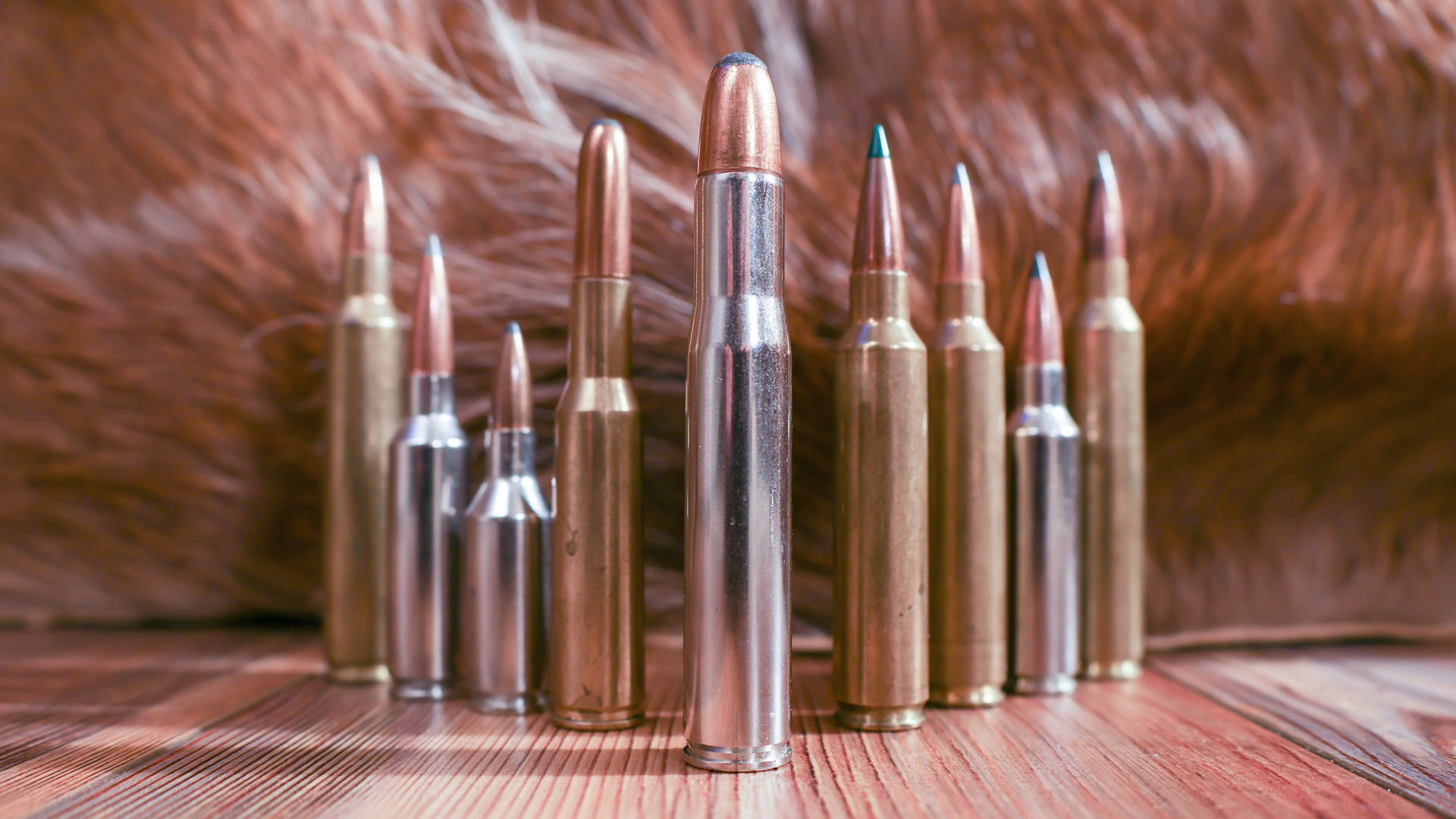
If you are in bear country, this is a no-brainer: Despite what is trending on the Internet these days, you need a big, powerful handgun. The odds of getting off more than one or two shots in an attack are very low, so don’t worry about magazine capacity. A big, heavy, powerful bullet that will penetrate deep and break bones is your best bet for survival. That almost always means a revolver. My rule of thumb for guns and cartridges for bear protection is “4-3-1”: a minimum of .40 caliber, 300 grains of bullet weight and 1000 fps velocity.
My favorite bear-country handgun is a Mag-Na-Port/Freedom Arms Model 83 single-action revolver in .454 Casull customized with a 5-inch barrel. In grizzly country I keep it loaded with 300-grain hard-cast bullets. Everywhere else I carry expanding-bullet factory ammo from Hornady or Federal. I have used this cartridge to take a lot of hogs, deer and black bears, and I trust it to protect me from anything that walks in North America.
There are a lot of powerful cartridges to choose from today. My friend Lucas Clark was attacked by a big male brown bear near his Alaska home while tending his livestock. He stopped the bear with a .500 S&W revolver. Lucas is a hard-core gun guy, but don’t ever talk to him about using little cartridges for protection!