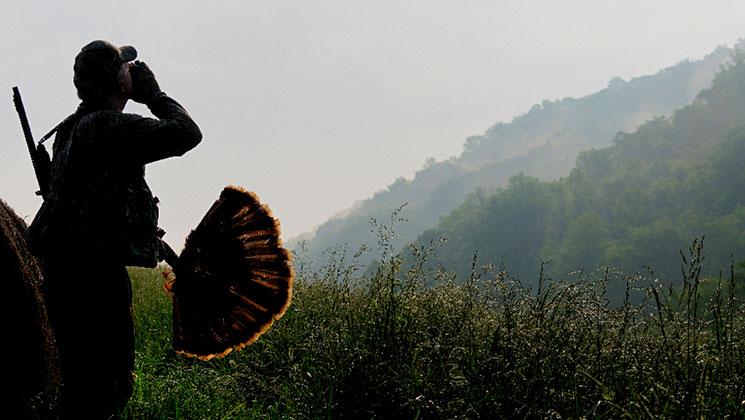
Many hunters in the Appalachian Mountains will tell you it is the most difficult place in the country to kill a gobbler. This includes West Virginia, Pennsylvania, east Tennessee, east Kentucky, north Georgia and western Virginia. The turkeys in this part of the world have been hunted since the days of Simon Kenton, and they are nobody’s fool—one wrong move at the wrong time and these turkeys are gone. Along with an innate suspicion of everything, which helps them survive, mountain turkeys have an ally that protects them: the sometimes horrendous topography in which they live.
In mountain country, you can go in one of two directions—uphill or down. Level ground can be almost nonexistent in some areas, and when you get out of the truck, that old gremlin known as gravity climbs on your back and whispers in your ear, “How bad do you want to get to this turkey?” Setting up on a gobbling turkey in the mountains usually entails a gut-wrenching uphill climb. This is just the price of admission; tighten up your boot laces, take off that jacket and go for it—you may be rewarded for your efforts, or you may not.
As wary as they may be and as difficult as mountain turkeys are to hunt, they are not invulnerable. Here are some tips that will help you with these denizens of the high country.

1. Forget What You've Been Told About Turkeys Coming Downhill
We have been told a gobbler will never come down hill to our calls, but turkeys walk up and downhill every day in this country. While we would much prefer to call to a gobbler that is below us, if the situation merits the need to call to a turkey uphill, do it. This will not always work, but sometimes it will. The drastic landscape of the mountains sometimes calls for drastic measures.
2. Sound Travels Differently on Steep Terrain
One of the greatest lessons the mountain turkey hunter can learn is that hearing turkeys is different on steep terrain as opposed to flat. The typical landscape here is often a high ridge with numerous smaller finger ridges running off of the highest point. The hunter can listen from a position on top of the ridge, but a turkey only a short distance down a steep slope may not be heard. Experienced mountain hunters have learned they may only have to move a short distance to hear a gobbler that had gone undetected. Likewise, a small ridge in front of you may have a turkey on the other side of it gobbling his brains out and you can’t hear it. This is especially true later in the season when the foliage is heavy.
3. Run-and-Gun is the Name of the Game
Because the terrain can be so extreme, moving and getting into position is very important. It is common to be engaged in a duel with a gobbler and for reasons known only to the turkey, he simply will not come to your position. He could easily walk (or fly) over there, but he won’t. You have to move in these situations, and the topography may actually work to your advantage. By keeping a ridge top between you and the turkey, you will be amazed at what you can get away with on a move. As long as the gobbler can’t see you, you should be good. A gobbler that hears you walking in the leaves may actually come over to check you out.
4. Shotgun Range is All You Need
Turkey hunters love to watch a big gobbler walk in from afar, strutting all the way. In mountain country, we don’t always get this luxury. An ideal scenario can be the turkey located below you under a steep slope. Hopefully you can set up on a narrow bench that is often found on the mountainside. The idea here is to position yourself so the turkey has to come into gun range to see you. Be ready—as soon as the gobbler steps onto the bench where you’re seated, start taking the slack out of the trigger. The tradition here is to be on him fast, if the turkey flops over the brink of the hill you may in for a long retrieve of your prize.