As the sun melted over a maize horizon and poured gold into my eyes, I struggled to focus on the shot and not the massive antlers. On a guided hunt, the only thing the hunter really has to worry about is making the shot. It was from this hazy vantage that I was enlightened by another truism: Neither trophy deer nor trophy deer guides exhibit much patience for hunters who don’t shoot. I felt 135 yards was simply too far. Seconds later, as the giant mule deer turned and bounced back into the cover of the corn, and my guide turned and started back to the truck, I also felt a tinge of regret.
Now I’m not crying; I feel lucky just to go on such a hunt, and hunting isn’t just about killing and blah blah blah—but I’d be lying if I said I didn’t want to feel that buck’s horns in my hands. For this expensive hunt halfway across the country I would’ve carried a .300 magnum with an optic made by Hubble if my Colorado tag hadn’t mandated otherwise. So I’d chosen a new gun from CVA called the Apex, mainly because it’s about as close as a muzzleloader gets to a modern centerfire. In nine of its 11 forms it is a centerfire, which means I wouldn’t have to worry about shelling out huge cash for a .300 mag. in the future if this muzzleloading business didn’t pan out.
Connecticut Valley Arms has come a long way from its roots as a distributor of frontier-era replica rifle kits. These days you won’t find kit guns, flintlocks or any wood at all in CVA’s catalog. The Spanish-owned, Georgia-operated parent company, Blackpowder Products Inc. (BPI) has changed its CVA brand logo from a flint-and-hammer to simple broad lettering—befitting of the modern products it now sells to a much wider market. Currently CVA is best known as a maker of low-to mid-priced in-line muzzleloaders, but I believe the rifle you see here foreshadows a dynamic future. As evidence, BPI has invested heavily in a state-of-the-art manufacturing plant in Spain’s famous Basque region.
CVA’s new flagship, the Apex, is symbolic of its modernization as a company; it represents a departure in style from its prior rifles, an enhancement in quality via superior manufacturing techniques and a wholesale shift to mass appeal. Yet it continues the sales formula that has worked so well for it and its main competition, Thompson/Center, over the last few years. That formula is: Build a dependable, simple firearm that hunters can use for everything; fill it with features that work, then make it affordable and hip. Then back it up with a strong warranty. We believe the Apex accomplishes these things so well—and with style—that we awarded it American Hunter’s Golden Bullseye.
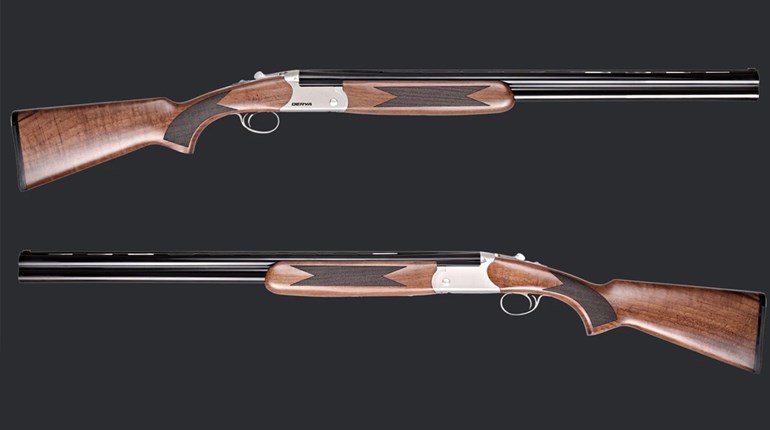
The Apex is a break-action, single-shot rifle that lends the shooter the capability of switching barrels to meet specific needs. Currently a .22 LR, a .50-caliber muzzleloader and nine centerfire barrels are available for additional purchase. The Apex is not particularly novel in function—it borrows from T/C’s Encore—but overall it is exceptionally well made and costs less than its competition. As an NRA staffer said in a Golden Bullseye meeting, “Its parts come together to form something greater than they should.” The Apex has features I want—a pre-mounted optic rail, fluted barrel, stainless steel, reversible hammer spur, outstanding trigger and recoil pad—but does not sacrifice weight or add undue cost with gimmicks. The only negative that surfaced during testing involved the plastic inserts placed under the muzzleloader barrel to hold the ramrod in place. They consistently slid out, causing a rattle.
The Apex’s stock design and low-profile frame give it classic rifle handling characteristics unlike current switch-barrels on the market. Whereas the Encore and CVA Optima Elite mimic T/C’s Contender platform—thus assuming a rather radical pistol-with-buttstock-carbine look and feel—the Apex feels more like a Ruger No. 1. This is not to say that these other rifles are incapable of shooting well—there are scores of happy Encore owners—but I believe nearly vertical pistol grips and ultra-high-comb stocks are less intuitive to aim and shoot. If I close my eyes and shoulder the Apex, my eye and hands align more or less linearly down the gun. To put it another way, if the Apex had a shotgun barrel (it doesn’t) I could shoot a decent round of skeet with it. I realize rifles aren’t bird guns, but this illustrates the Apex’s feel. In more tangible terms, a straight-line stock can reduce felt recoil and muzzle flip.
I intuitively found the action release lever and broke open the gun to expose the chamber. The lever forms the rear curve of the trigger guard. When squeezed it causes the entire trigger assembly to relinquish its bite on an underlug welded to the barrel. This allows the barrel to pivot on a hinge pin that is the link between the receiver unit and the barrel. I switched barrels in two minutes by removing the fore-end via two screws, tapping out the pin, swapping barrels and reversing the process.
The Apex boasts a truly outstanding trigger. It can be tuned externally with a screwdriver. I dialed mine to 3 pounds.
As you can see in its ads, CVA really touts its Bergara barrels that come standard on the Apex. During a lengthy CNC manufacturing process these barrels undergo a three-step diamond honing procedure. CVA reps say it creates a level of bore smoothness and uniformity similar to custom hand-lapped barrels. It’s notable that one of the most respected match-grade barrel makers in the world, Ed Shilen, consulted on the Bergara project. I assume he was paid for his services, but considering his reputation, I believe him when he says they are excellent mass-produced barrels.
I was not overwhelmed by the two .30-06 barrels I tested, however. Both heavily favored some loads over others, and they exhibited some verticle stringing after heating up. While 1.31 inches is a good group, it’s possible that guns such as the Apex might pay a small price in accuracy for the ability to switch barrels quickly. On the other hand, one colleague tells me his Apex in .243 Win. is a tack driver.
For the muzzleloader, I found 120 grains of Triple 7 with Parker bullets produced the tightest groups. Then I removed the scope per Colorado law, installed excellent XS System Ghost Ring Hunter iron sights and packed for Denver.
After hundreds of combined man-hours trying to relocate the now-skittish big buck, we spotted him on the edge of the corn just before another sunset. My guide, Aaron Neilson, leaned in my ear as the half-mile stalk neared climax.
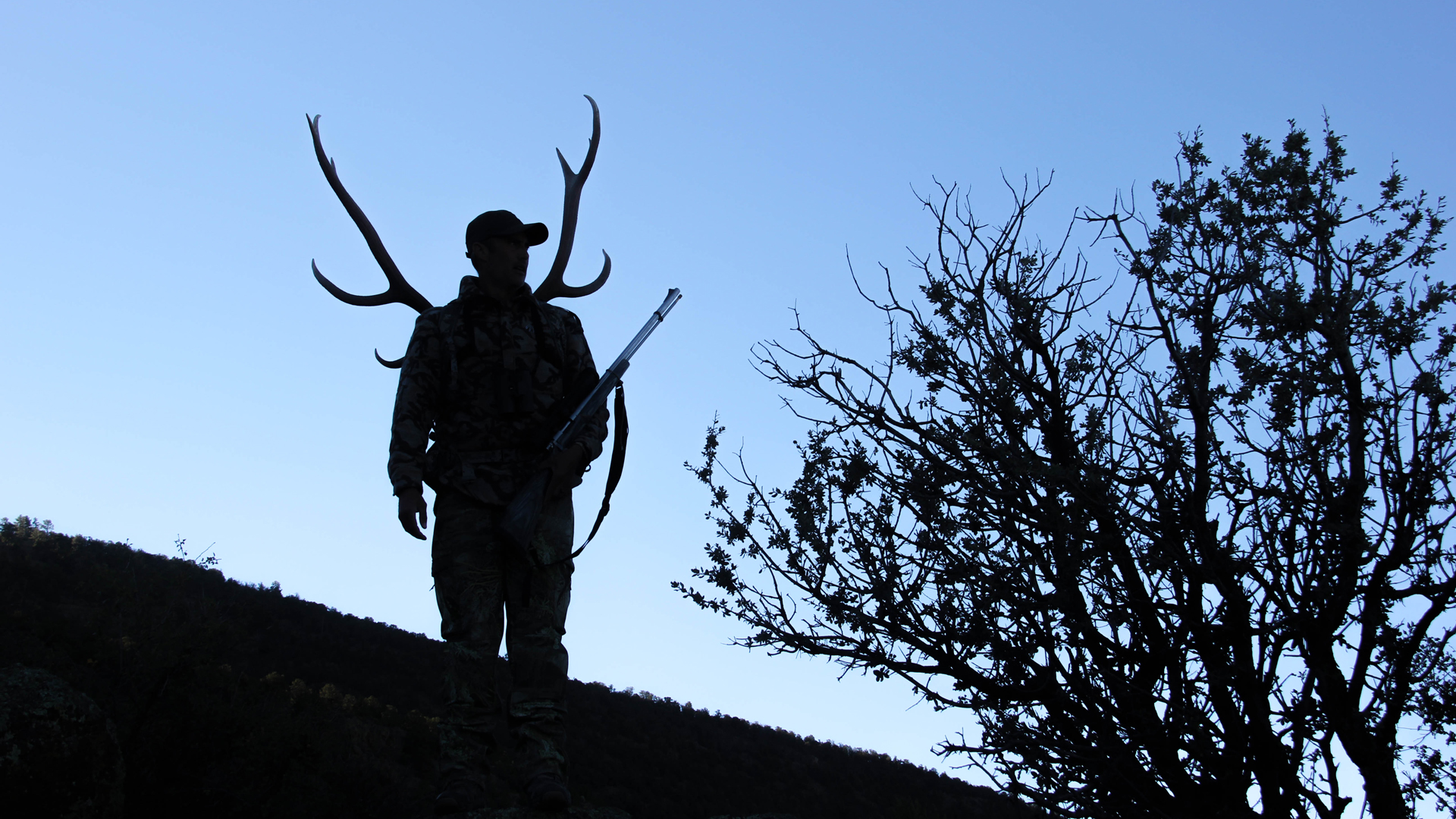
“Shoot the one on the left now!” he snarled, leaving no doubt that the patience of he and the buck were rapidly waning. As Neilson and I stepped from cover, I cocked the hammer, centered the blade in the rear aperture instinctively and concentrated only on my breathing, the sight picture and a smooth pull. It surprised me as a good pull should, and smoke ensued. Before I finished reloading Aaron slapped my back, and I saw antlers sticking over the tall chafe. When I finally laid my hands on them I was surprised and delighted to feel the soft touch of velvet, a freak occurrence for late October. As I admired the buck in the last golden beams of light, I realized I was wrong about guided hunters only having to worry about the shot: Now that I’d made it, I worried about the taxidermy bill. But I’m not crying.
Specs:
770-449-4687, www.cva.com
Type: break-action single-shot centerfire, muzzleloader or rimfire
Caliber: .50-cal. blackpowder; 10 rifle chamberings from .22 LR to .45-70 Gov’t.
Rifling: button rifled; muzzleloader, 6-groove, 1:28" RH twist; centerfire, 6-groove, 1:9"-1:20" RH twist; rimfire, 6-groove, 1:16" RH twist
Sights: none; Durasight rail for scope
Trigger: adjustable, 3-6 lbs.
MSRP: $651, black stock; $731, Realtree APG stock; additional barrels, $309-$349