First Look: Weatherby Element Semi-Auto Shotgun

by
posted on February 13, 2015
** When you buy products through the links on our site, we may earn a commission that supports NRA's mission to protect, preserve and defend the Second Amendment. **
weatherby.jpg

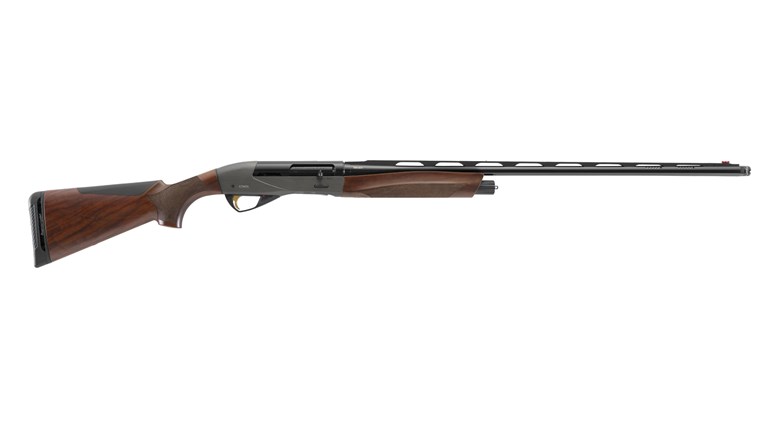
Weatherby has been in the shotgun business for decades, but now it has a product that’s sure to appeal to upland hunters who still prefer walnut over plastic. The Element is an inertia-operated semi-auto that’s as attractive as it is affordable. Here’s the scoop.

1. The Element’s inertia action is Weatherby’s first. 
When Paolo Benelli’s patent expired in 2006 the door creaked open for the Italian shotgun maker’s competition. Browning introduced an inertia-operated version of its venerable A5 for waterfowl. Weatherby, however, chose a lighter, more upscale route with its Element. Why inertia? While inertia actions do not lend the recoil-mitigating properties of gas guns, they’re generally more reliable because grime is vented out of the barrel and not back into the chamber. And thanks to fewer parts in the Element’s fore-end, its balance point is between the hands—conducive to upland point shooting.

2. The Element retains Weatherby’s class. 
Much like with this iconic California company’s Mark V rifles of old, Weatherby designers opted for a high-gloss AA-walnut stock, a blued metal finish and a golden trigger rather than the plastic stocks and matte finish seen on many current hunting shotguns. Much like its new action, Weatherby looked to Italy for the Element’s aesthetics, inasmuch its ergonomics and slick-handling.

3. Lightweight versatility is the Element’s cup of tea. 
Available in 12-, 20-, and 28-gauge, there’s no upland task it can’t down like an opening-day dove. Ranging in weight from 6 to 6.75 pounds depending on gauge, it comes with 3-inch chambers (2 3/4-inch in 28-gauge), three choke tubes, a four-round magazine and a 26- or 28-inch barrel. Doves, ducks, pheasants, grouse or even turkeys—the Element is an all-around upland special.

4. At last, a blue-collar price tag on an executive’s shotgun. 
Despite its lustrous finish, the Element is priced much less than its closest competition, the Benelli Montefeltro, yet at $1,099 MSRP, it’s closer to the Franchi Affinity it resembles. Either way, with its proven action, walnut stock, great wood-to-metal fit, aluminum receiver, vent rib, chrome-lined bore and checkering, it’s a-whole-lotta shotgun for a grand.

Latest

LEDEM3500 Waterfowl MOOBL

New for 2026: Stoeger M3500 Waterfowl Mossy Oak Bottomland

Stoeger has expanded its M3500 Waterfowl Special series with a new model finished in Mossy Oak Original Bottomland camo. Paired with a Patriot Brown Cerakote receiver and barrel, the M3500 Waterfowl Special in Mossy Oak Original Bottomland is purpose-built to blend into flooded timber while standing up to harsh, wet environments.

Can Hunting Become Cool Again?

Is hunting becoming "cool" again? In an era when America’s top podcaster and cage-fighting commentator, Joe Rogan, talking hunting with Yellowstone superstar Luke Grimes seems almost commonplace, you'd have to think that the popularity of hunting is on the ascendency. How can we help it along? Read on, for Frank Miniter's thoughts on breaking hunting back into the mainstream.

Head to Head: 7x57mm Mauser vs. .308 Winchester

The 7x57mm Mauser and the .308 Winchester are two of the most versatile and popular cartridges to make the jump from military to field use. Which makes the more sensible choice for the big game hunter? Follow along as Phil Massaro takes a dive into this pair of classics.

New for 2026: Winchester Long Beard Tungsten

Winchester Ammunition has added Long Beard Tungsten to its turkey hunting lineup of shotshells in 2026.

RMEF Grants $400,000 to Support WAFWA Wildlife Movement Projects

The Rocky Mountain Elk Foundation (RMEF) recently awarded a $400,000 grant to the Western Association of Fish and Wildlife Agencies (WAFWA) to fund three state-led projects aimed at conserving, restoring and enhancing big game seasonal habitat and migration corridors in Nevada, Washington and Wyoming.

Suppressor Etiquette: Is It Rude Not to Use One When You Can?

If you legally can use a suppressor, is it becoming rude not to? A recent hunt in New Zealand, where suppressors are almost required equipment, got Brad Fenson thinking about the question. Follow along for the pros and cons of cans, as well as a discussion of the changing cultural norms surrounding their use.

Interests


Get the best of American Hunter delivered to your inbox.