I swear: a few more years of digital innovation in optics and we’ll be reduced to programming our gear to do our hunting for us. Just punch in species, sex and size. Then sit back and wait for your scoped rifle to drag back your trophy—butchered, wrapped, frozen and finished as a skull mount.
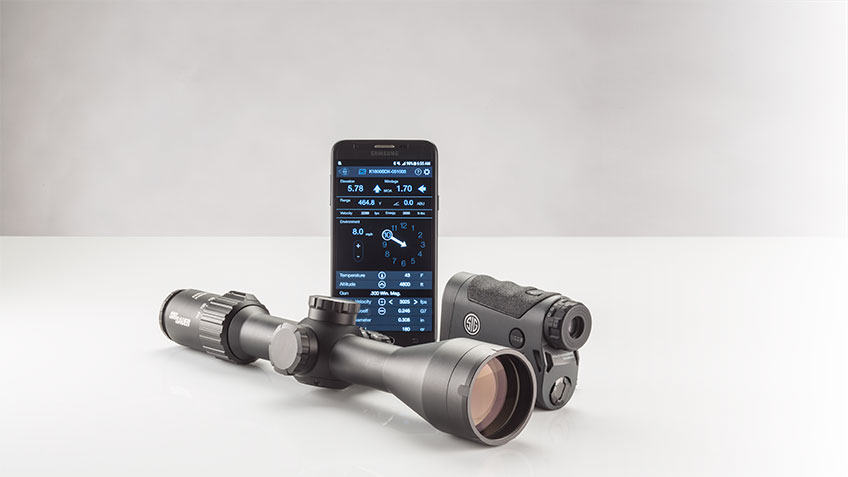
Until then, however, we can enjoy the incredibly easy SIG Sauer BDX system for putting bullets on target. This app/rangefinder/scope system will, literally, show you exactly which aiming point to use for a direct hit out to 800 yards. As SIG advertises, just “connect the dot.”

Let me restate that another way so you fully grasp the implications: just aim the laser rangefinder at your target, push the button and get ready to shoot. The unit lights up the usual distance and shot-angle readings, but then it does something special. It sends that information plus stored ballistic data via Bluetooth to the scope. The scope in turn uses this info to illuminate one of dozens of aiming points on the vertical line of the reticle. The correct one. The one that matches the drop of your bullet at that distance.
The good news is you still get to do the hiking, glassing, stalking, shooting and butchering. The SIG rangefinder and scope do the hard part—the math. In my book, that’s a pretty valuable service.
If you’ve been paying attention to current long-range shooting advancements, you’ll know there’s a big learning curve, even with today’s outstandingly accurate rangefinders. It’s one thing to know the distance to the target and the trajectory curve of your bullet. It’s another to calculate the drop, let alone drift. There are extenuating conditions like slope, altitude, barometric pressure, humidity, temperature, etc. Let’s see, do shots go higher with more humidity or lower? Does cold air make bullets faster or slower? How does trajectory change at 10,000 feet vs. sea level?
The BDX system comes to the rescue. BDX stands for Ballistic Data Xchange, which is exactly what happens between these three units. Yes, three. In addition to the scope and rangefinder, you’ll need a smartphone to make this system work. Like so much technology these days, the BDX system runs via an app. A phone is not needed in the field for the scope and rangefinder to communicate, but it is required to program them to work properly for the trajectory of the bullet/load you’re shooting and to send data on changing environmental factors such as wind and temperature. The SIG Sauer BDX app can be downloaded free from Apple and Google Play app stores.

The app is the portal through which you enter the usual pertinent parameters such as your bullet’s muzzle velocity, weight, ballistic coefficient and zero range. Inputs for altitude, temperature, wind direction and speed can be entered manually or downloaded from your smartphone’s GPS, certain digital anemometers and online weather apps. The BDX app then locks in this data as a saved rifle/load. Pair it with the rangefinder, and the onboard Applied Ballistics Ultralite calculator does the calculations and sends the correct hold signal to the scope, all in an instant. An external, blue diode on the scope’s magnification dial flashes to indicate the scope is successfully communicating with the rangefinder. A dot on the vertical portion of the reticle lights up to show you where to hold to compensate for bullet drop, and another dot on the horizontal portion gives you the wind hold. Line them up on the target and, if you don’t wiggle or flinch, that’s where your bullet will sail.

If you’re thinking this sounds like what several riflescopes with built-in rangefinders have been doing for years, you’re right. What’s different is the system’s SIG Sierra3BDX scope has a standard profile rather than an unusually bulky one because the rangefinder guts are in a separate, handheld Kilo BDX unit. If the batteries die, or even if they don’t, you can use the Sierra3BDX as a typical, non-digital scope. Both the Sierra3BDX scope and Kilo BDX rangefinder are available in several magnifications, objective sizes and effective rangefinding distances at varying prices. SIG offers the optics separately or in scope/rangefinder combo kits.
This review doesn’t fully describe all the BDX system can do, but I needed to leave room to assess the instruments themselves. The 4.5X-14X-50mm scope I tested was no second-rate excuse to showcase digital wizardry, but a top-line, fully featured model with .25-MOA adjustments, a second-focal-plane reticle, high-definition and high-transmittance HDX lenses, and SpectraCoat ultra-wideband anti-reflection coatings. I found contrast high and sharpness across the field impressively crisp. Flare was controlled nicely at all power settings with just a few highlights when looking directly toward the sun. I’d shoot with this scope even if it had no BDX technology.

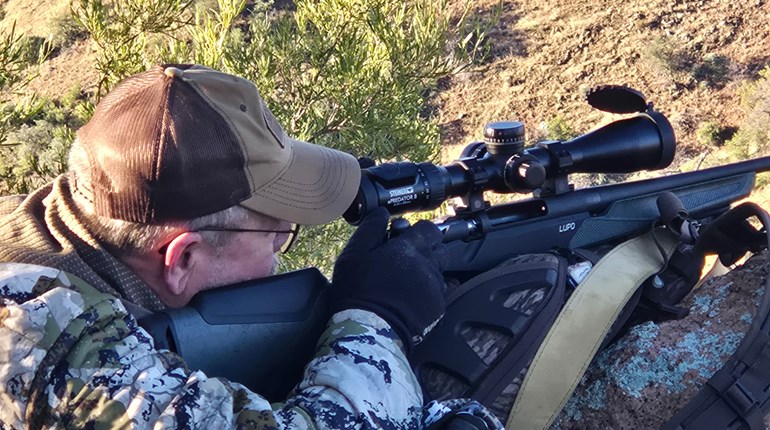
Mounted atop a Mossberg MVP Precision rifle chambered in 6.5 Creedmoor, the fogproof, waterproof scope tracked accurately and performed as promised, putting bullets within 1 MOA of point-of-aim at 100, 200, 359, 573 and 603 yards. The Bluetooth transmissions and reticle adjustments happened so quickly that I had to ask a friend to range targets while I watched the reticle light up to match. Thanks to such split-second performance, it was as simple as “600-yard gong. Send it.” We’d be halfway toward dropping the hammer on the 350-yard gong before the thwok from the 600-yard target reached us.
The KILO1800BDX rangefinder was equally impressive, hitting ranges to 880 yards off pines and oaks, 1,289 yards off highly reflective cliff faces in shadow and bright sunlight. On scan mode new ranges flickered up as fast as I could pan from a 10.5-yard aspen to a 363-yard oak thicket to a 467-yard juniper ridge. There was a second’s hesitation when I jumped from the ridge to the cliff beyond before the 1,289 reading popped up in red. Shooting through a hole in the branches of an aspen, the narrow beam divergence of this rangefinder’s laser easily read the 732-yard hillside beyond. All this testing was conducted in bright daylight.

Besides to input real-time environmental factors, another reason you might want to bring your smartphone with the BDX app to the shooting range is to switch loads. Or rifles. With your favorite rifles/loads already programmed into the app, you merely select the appropriate profile. It’s then sent to, and stored by, the rangefinder. From then on, each time you hit a range reading, the scope reticle lights up according to where the bullet from the selected rifle/load will land. I set up the app for the Mossberg with a Nosler 140-grain Match load at 2644 fps, a Federal 130-grain Berger load at 2820 fps, and a Hornady 143-grain ELD-X load at 2664 fps. (Muzzle velocities were all measured over an Oehler 35P chronograph; the calculations are only as exact as the info you provide.)
To highlight the simplicity of shooting a BDX-equipped rifle, I loaned the Mossberg to Branded Rock Canyon marksmanship student Ricardo Malta and told him to put the illuminated orange dot on the gongs at the ranges I announced. I then punched the KILO1800BDX and called several out to 600 yards. Ricardo, a raw recruit to shooting, smacked them all.
Is the SIG Sauer BDX system easy? It’s so easy it’s scary.
Technical Specifications: SIG Sauer Sierra3BDX
• Type: variable-power riflescope
• Magnification: 4.5X-14X
• Objective Lens Diameter: 50mm
• Eye Relief: 3.8″
• Exit Pupil: 8.9mm (4.5X), 3.6mm (14X)
• Field of View @ 100 Yds: 19.9′ (4.5X), 6.7′ (14X)
• Reticle: second focal plane; illuminated BDX-R1 Digital w/Auto LevelPlex anti-cant; 10 brightness levels; MOTAC motion-sensing on/off
• Adjustments: 55 MOA in .25-MOA increments
• Coatings: fully multi-coated; SpectraCoat ultra-wide broadband
• Dimensions: tube diameter 30mm; length 12.75″; weight 24.9 ozs.
• Construction: one-piece anodized 6061 aluminum tube; HDX glass; nitrogen-filled; waterproof, fogproof, shockproof; side parallax adjustment; Bluetooth-enabled BDX
• Accessories: two CR2032 batteries, lens cloth
• MSRP: $839.99; sigsauer.com
Technical Specifications: SIG Sauer Kilo1800BDX
• Type: laser rangefinder
• Magnification: 6X
• Objective Lens Diameter: 22mm
• Eye Relief: 17mm
• Exit Pupil: 3.7mm
• Field of View @ 100 Yds: 34′
• Measurements: 5-2,000 yds. in .1-yd. increments; LightWave digital signal processing w/HyperScan refresh rate; Angle Modified Range, Line of Sight modes; Applied Ballistics Ultralite calculator; Bluetooth-enabled BDX
• Coatings: fully multi-coated; SpectraCoat ultra-wide broadband
• Construction: magnesium body w/rubber armor
• Power Source: CR2 lithium battery (included)
• Dimensions: length 4.1″, width 1.3″, height 2.9″; weight 7.9 ozs.
• Accessories: nylon pouch, lanyard
• MSRP: $479.99; available in BDX combo kit w/Sierra3BDX scope for $1,079.99; sigsauer.com