My first hunt using a handgun exclusively turned out to be less than a positive experience. I didn’t know any better and loaded my Colt New Frontier revolver with .22 ammo that had solid-lead bullets. The poor cottontail that I ran into that day took somewhere around eight rounds before it succumbed.
I had no mentors or teachers to guide me into the hunting experience—well, not in the flesh. I read everything I could about hunting and guns, and over the years I amassed a decent library. But in the early 1970s there was precious little literature on hunting with a handgun. Not long after that initial hunt, I learned that high-speed, hollow-point ammunition was key to a successful small-game hunt. Since then I have successfully taken dozens of wild pigs and deer, a bison, a nyala and a blesbok with handguns.
For the purposes of our discussion here, I am referring to those handguns that can be carried in a holster on your person. There has been a tendency for some to hunt with rifles with abbreviated barrels and the buttstock sawed off. These guns stretch the definition of handgun to its limits, and I have no interest in them. If you like them, fine, but then if you are of that ilk you probably don’t need my advice. My own upper limit on these things is the Thompson/Center Contender, and if you have really big hands, include the Encore pistol. Also, with very few exceptions, semi-auto pistols should be relegated to two-legged predators—self defense. Most popular chamberings are just not powerful enough to humanely and reliably take big game. The exceptions would include the Desert Eagle in its heaviest chamberings and full-size pistols in 10 mm Auto.
If you have a relatively accurate rimfire handgun, you can get started hunting with handguns. Shooting varmints and pests is the best way I know to cultivate, sharpen and maintain field-shooting prowess. One of my favorite springtime hunts is to take my Kimber 1911 Rimfire in my regular 1911 carry holster and take a walk in an area with plenty of ground squirrels or prairie dogs. I take any shot where I can see the critter and that’s safe to shoot. Draw, acquire the target in the sights and press… it is a humbling experience. Nonetheless, it helps you spot game, shoot under real field conditions, estimate range and go through the shooting process under the stress of time. If you can achieve a 50-percent hit ratio, you will perform splendidly when you’re ready to move toward big game.
Transitioning to center-fires should not be difficult. The secret is to be brutally honest regarding your shooting abilities in the field. You may be able to keep all your shots from your .454 Casull inside 6 inches at 150 yards from a comfortable benchrest with plenty of pads, but can you do that from a kneeling position on a hillside? Shoot paper—a lot of paper—from a variety of field positions. Paper, unlike steel or other targets, never lies and provides a lasting record of your shooting prowess. If you have a shooting buddy, set paper targets up at unknown ranges for each other—no peeking—and engage them as you would during a hunt. That is how you’ll learn your range limits.
Most burgeoning handgun hunters buy way too much gun at the beginning. Don’t let your ego or lust for power override good sense. That .500 Magnum may be just the ticket for big bears, but until you learn how to handle recoil under field conditions, a 6-inch-barreled .357 Mag. will kill all the deer you intend to shoot provided your shot placement is correct.
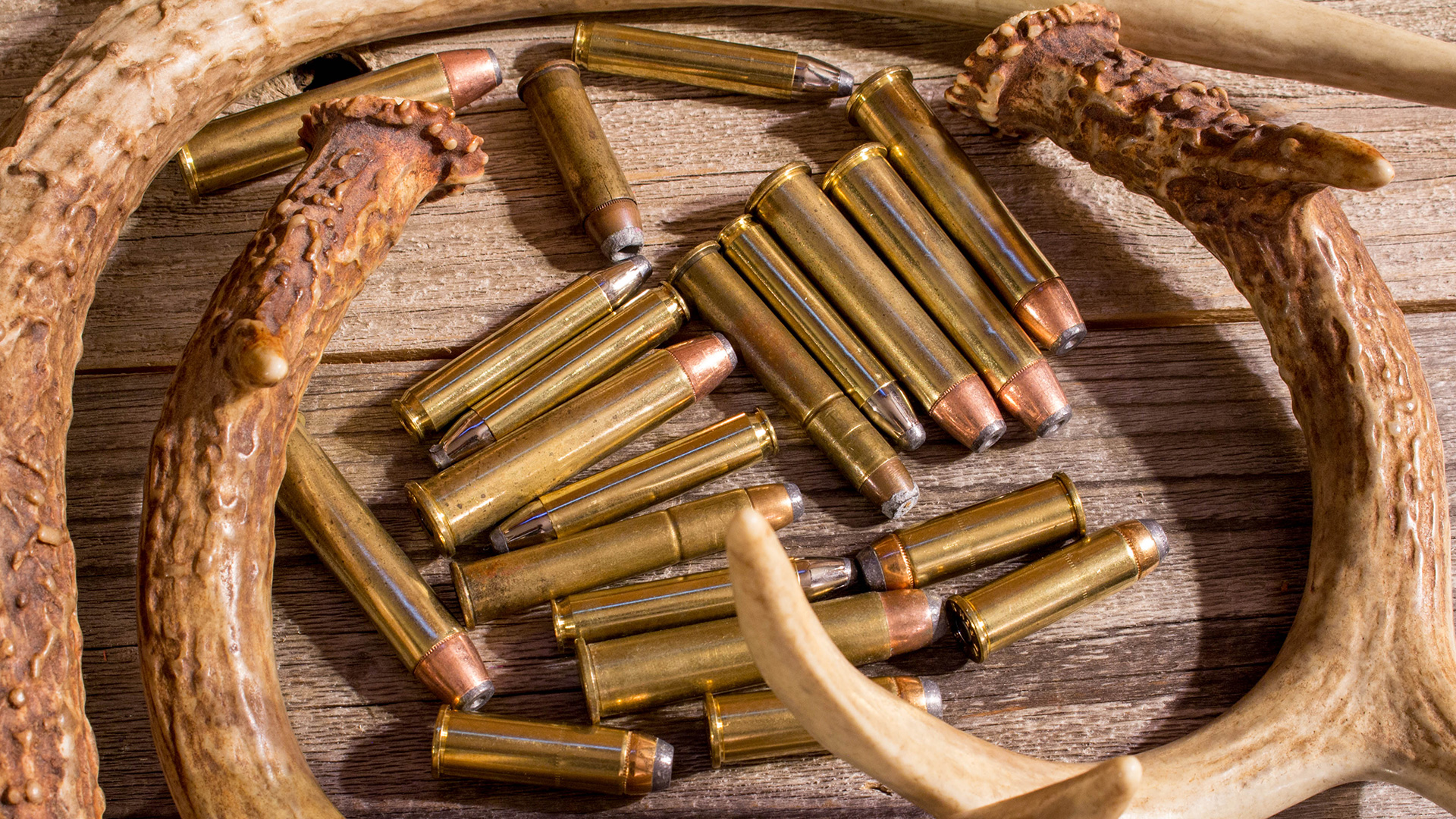
As with any hunting, shot placement, along with bullet choice, is key to making regular humane kills. On small game a .22 LR hollow-point in the chest or the head will get the job done. With smaller varmints—ground squirrels and prairie dogs, for example—light-for-caliber hollow-points will produce spectacular results. On deer-size game I want a heavier bullet. In my .44- and .45-caliber revolvers I rarely use a jacketed bullet, preferring to cast my own 250- to 270-grain semi-wadcutters from a relatively hard alloy. There is nothing wrong with jacketed bullets in revolvers; I have never had any failures with my cast bullets, so I simply prefer them. In terms of shot placement, visualize a volleyball between the deer’s legs in the chest. You want your bullet to pass through that “volleyball” to anchor the animal.
At some point you will want to move up in power and range. In revolvers that usually means going from a .44 Magn. up to a .454 Casull, .460 Smith & Wesson Mag. or a .500 Smith & Wesson Mag.—though John Linebaugh’s .475 and .500 cartridges are popular as well. Some like to use these heavy thumpers on deer, but I think it’s a bit much unless the ranges you shoot are long. I used a .500 S&W Mag to take a young bull bison some five years ago. When the critter you are shooting approaches a ton in weight—and especially if it can stomp a mud hole in your rear and walk it dry—you’ll need a big bullet at relatively high velocity to settle the matter in a timely manner.
When I went to Africa in 2008, the animals ranged from the deer-sized brushbuck to elk-sized kudu. We tried to keep the ranges short but hunting is hunting, and the animals often have a say in the matter. I shot a nyala at 122 yards with a .460 S&W Mag., and one of my buddies, Bill Booth, took a kudu at 275 yards with a .500 S&W Mag. In order to reliably make shots like these you do need the higher velocity of these cartridges.
Optical sights help the handgun hunter just as they do riflemen. On the other hand they also accentuate shakes and movement. As with riflemen, the variable-powered scope dominates the market. Most of us find the 2-6X scope to be the best choice for handguns. At 2X the field of view is wide enough to pick up targets quickly, and I rarely crank my scopes above 4X. At that power level I have enough resolution to place any shot I would take; anything more powerful and I find the shakes are too much for the scope to be any use.
A rest becomes almost a necessity for anything past 50 yards or so. That rest can be a bipod attached to the fore-end of my G2 Contender or a sandbag on a varmint bench. Most of the time I’ll have a folding-tripod set of shooting sticks along with me. I packed along a set of Stoney Point shooting sticks on the Africa hunt. Without them I would have come home empty handed. Those same sticks stay in the ground blind that I set up over the river at the back of my property during deer season.
Packing the handgun depends upon its size and how you plan to hunt. I use everything from a traditional belt holster to shoulder rigs. When I drag along my G2 with a .30-30 Winchester barrel down to the ground blind I simply stuff it my hunting pack. I am currently having a tanker-style holster made for my Smith & Wesson K-22 for varminting from a truck. When choosing a rig don’t neglect to consider how you will carry some spare ammo. You won’t need 60 rounds of ammo in magazines, but a spare cylinder full for a revolver or, say, three rounds for a single-shot pistol should keep you in the game.
Like bowhunting, the handgun hunter deliberately puts some additional restraints on his or her hunting. Stalking and ambush prowess become more important, and that is the allure of hunting with the short gun. Start slow and build your arsenal as your skill set grows. But be forewarned: Handgun hunting is addictive.