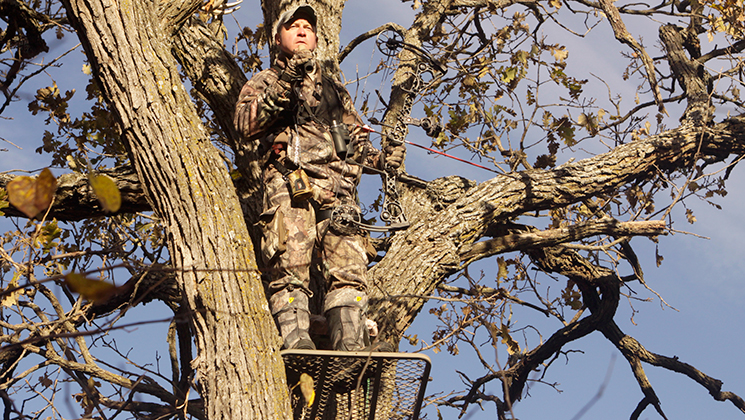
You’d think sitting in a treestand above the eyesight of fearful whitetails would keep you hidden, but you’d be wrong. Hunting in a treestand is a first good step, but to make that stand productive you need to make it disappear as convincingly as a David Copperfield trick.
Pick a Winner
Start the disappearing act by picking the perfect tree. Reject skinny trees with no limbs unless that’s your only option. Think big. Mature trees with sprawling limbs offer ideal camouflage when you hang your stand in the maze of branches. They also don’t sway as much in the wind. Look for mighty oaks, brushy spruces, old hickories, ancient cottonwoods and other brawny species.
Stay Off the Trail
We all hope for a close shot, but pushing the distance a bit may help you stay hidden. Stands set right over a trail or next to it bring you closer to a deer’s security system. You catch more movement when it’s happening right next to you, and so do deer. Place your stand at least 20 yards from a major trail to increase the likelihood of veiling movement. It makes even more sense when hunting with the distance advantage of a firearm. But remember, every yard you back up from a trail increases the possibility of vegetation obstructing your shot. Clear shooting lanes appropriately, but sparingly.
Go Back
Hang your stand on the backside of a tree. By pointing your stand away from a trail, you can use the tree trunk to mask movement, such as the extremely visible draw of a bow. Since whitetails are unpredictable, especially during the rut, standing and hiding behind the trunk opens up the opportunity to swivel. You’ll be cloaked by cover when a buck roars by.
Hang It High
You gain obscurity by hanging your stand a bit higher. It places you farther above a deer’s normal eyesight. It also surrounds you with more limbs and branches. An added bonus is scent camouflage. Higher means your scent wafts well over a deer’s olfactory alarm system. How high? Twenty feet is a good average. If you go much lower, deer have more ability to catch movement. Go much higher with a bow stand and shot angles can become extreme, making it difficult to thoroughly pierce vital zones.
Add Cover
Finally, if your tree lacks foliage, prune some nearby branches and zip-tie them to other limbs around your stand to make it disappear. Check to ensure the new limbs won’t affect your shooting or visibility. Too much cover can be as bad as too little.