When I cooked at a restaurant in Provence, I became enamored of the flavors so commonly used in southern French cuisine. The land there is very dry, which means they don’t have verdant grass to rely on to feed herds of cows. As a result, they raise bulls for meat and use olive oil instead of butter. This was all strangely new to me, having come from New York kitchens where filet mignon and butter sauce were all the rage. But I grew to love it, and brought that inspiration back to the states with me and often use it in my wild-game dishes.
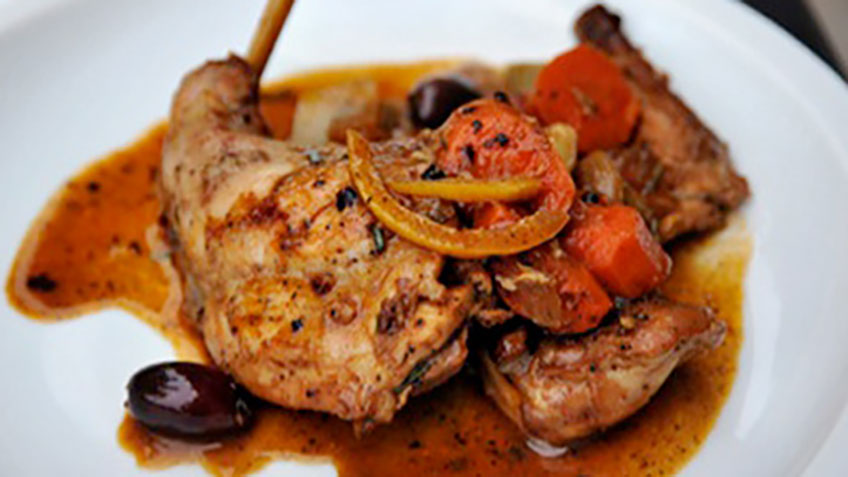
Deriving from the French word “braiser,” braising is one of my favorite techniques with rabbit—and game-meat in general—because it makes the meat fall right off the bone. I don’t think I’ve ever consumed a braised anything that wasn’t delicious, and it lends itself especially well to game meat, which contains less fat and more muscle tissue. In true French form, this braised rabbit is a multi-step process, but it is worth it. The marinade helps tenderize the meat and that little bit of flour gives the meat a thick browned coating. And if you don’t have rabbit available, chicken makes a very nice substitute.
Preserved lemons are a great flavoring element to game and fish dishes, and are one of the things that make this dish unique and decidedly “Mediterranean.” They add a briny flavor with just a hint of mild lemon. They are commonly found in Middle Eastern dishes, where the rind is removed from the pulp, rinsed and cut up. I have used Meyer lemons often, which are the best in my opinion, because they have a floral undertone. A small amount goes a long way, and one jar will last many months on your shelf. Just be sure to rinse the rind very well under cold water before adding it to a dish, and reduce the amount of salt you add to your dish to compensate for the salt in the lemon. You can buy preserved lemons in specialty stores or online, but even better, you can make them using my recipe.
As for the vegetables, you can use anything that inspires you, and since this time of year we have so many beautiful vegetable options, you can make this dish into a grand experiment. I used simple carrot, onion and celery, but bok choy, kale, radishes, swiss chard, turnips, parsnips and so many other things would be interesting. Pretty much anything that a rabbit likes to eat goes well here!
I’d also recommend, for simplicity’s sake and for presentation, that you try cooking this in a large cast iron skillet and then simply serve it tableside in the same skillet. You could even use several smaller individual skillets. It seems to be how they like to do it in the Mediterranean, and it has such a nice look on a summer dinner table, and it also minimizes clean up. Give this a try sometime, with rabbit, chicken or even your favorite fish. It is a little Mediterranean escape in a single summer meal.
Braised Rabbit with Olives and Preserved Lemon
(Serves 4)
For the Marinade:
1 whole rabbit, quartered, loins removed and rack chopped into large pieces
½ large onion, cut into chunks
1 medium carrot, cut into 1” pieces
1 celery stalk, cut into 1” pieces
3 cloves garlic, crushed
Bouquet garni of 1 bay leaf, 1 sprig thyme, 1 sprig rosemary, and 1 sprig parsley
½ bottle white wine
For the Braising:
1 tablespoon flour
2 tablespoons olive oil
1 tablespoon butter
1 tablespoon tomato paste
salt and pepper to taste
2 tablespoons red wine vinegar
2 cups chicken stock
Peel of ½ preserved lemon, julienned
¼ cup nicoise, kalamata or other mixed olives
1 teaspoon parsley, chopped
1 teaspoon rosemary, chopped
1 teaspoon thyme, chopped
For the Marinade:
1. Combine all ingredients except the rack of rabbit in a bowl and let sit at room temperature for at least one hour.
For the Braising:
1. Preheat the oven to 400 degrees F.
2. Lightly grease the rabbit rack, place on a sheet tray, and roast for 20 – 25 minutes or until well-browned.
3. In a heavy-bottomed skillet over medium heat, add the olive oil and butter.
4. Remove the meat from the marinade, pat dry and sprinkle with salt, pepper and flour.
5. Place the rabbit legs (skin side down) along with the loins in the skillet until well-browned. Turn over and brown the other side. Remove from the pan.
6. Add the vegetables from the marinade to the pan, and lightly caramelize in the same fat. Sprinkle with flour, stir and let cook for a few minutes.
7. Add the tomato paste and cook for another few minutes.
8. Deglaze the pan with the vinegar and reserved marinade, scraping up the brown bits on the bottom of the pan, and reduce the liquid until the sauce is thick.
9. Return the legs to the skillet, skin side up, along with the loins and roasted rack.
10. Add the chicken stock and bouquet garni, cover and let simmer for about 1 hour until the legs are tender.
11. Turn off the heat and add the preserved lemon, olives and chopped herbs, stir and let sit for 15 minutes before serving.