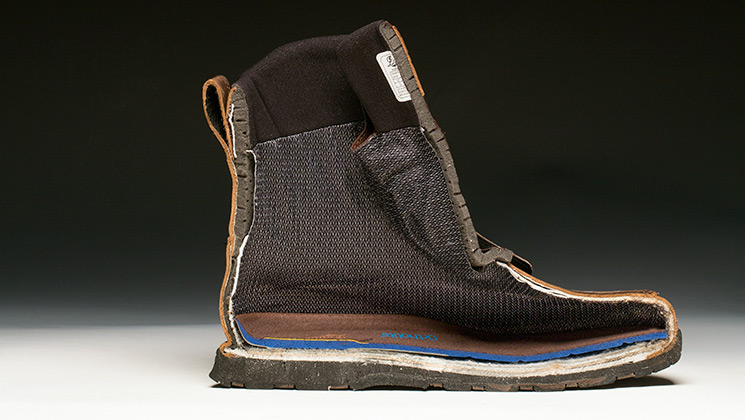
As a ruffed grouse fanatic who has hunted across North America for everything from pheasant to blue grouse and ptarmigan, I’ve earned certain opinions about upland boots. But I also asked Chris Curral, Danner’s product line manager for the hunting category, and Jeff Miller, L.L. Bean’s senior product designer for hunting and fishing, for their insights on what features matter. Both of their companies make a boot—the Danner Sharptail and the L.L. Bean Gore-Tex Kangaroo Upland Boot—designed especially for bird hunters.
Upper
Aboot’s upper needs to support your ankle and to be made of tough, lightweight material that can take abuse. The Sharptail uses waterproofed cow leather and panels of 900-denier nylon backed by Gore-Tex. L.L. Bean opts to use kangaroo leather over a Gore-Tex liner, as Miller says it is lighter than cow leather.
Insulation
Unless there is deep snow, I like an un-insulated boot for upland hunting. Curral says Danner (on the West Coast) sells more un-insulated than insulated upland boots. Miller says the opposite for L.L. Bean (in the East). This may be the result of their customers hunting in different environments.
Comfort
An OrthoLite footbed in the Sharptail provides cushioning. L.L. Bean uses a Goodyear welt to increase stability. An upland boot should be comfortable but shouldn’t feel like a sneaker. You want support over rocks and uneven ground.
Outsole
If the lugs are too aggressive, they’ll get clogged with mud. If they’re too shallow, you’ll slip on wet leaves and ground. Miller says the Gumlite rubber outsole on the Kangaroo is an example of the right compromise. The Sharptail has a similar tread that offers traction without accumulating debris.
Height
The height isn’t there to keep your feet dry. It’s there to give you protection and to keep debris from going in the top. The Sharptail is 8 inches high; the Kangaroo is 9 inches. For most people, a boot taller than 9 inches will bother their shin.
Weight
The Sharptail and Kangaroo both weigh about 3 pounds per pair. There are lighter boots, but most of those are made for trails. For busting cover you want boots made to handle anything.
Laces
If they’re too stiff, they won’t stay tied. If they’re too soft, they’ll tear or break.
Lower
The Sharptail and the Kangaroo both have “moc” toes (from “moccasin,” it means there is stitching around the top of the toe). This adds some strength, but it is as much about aesthetics as function.